Smart Bud
Concept and use cases
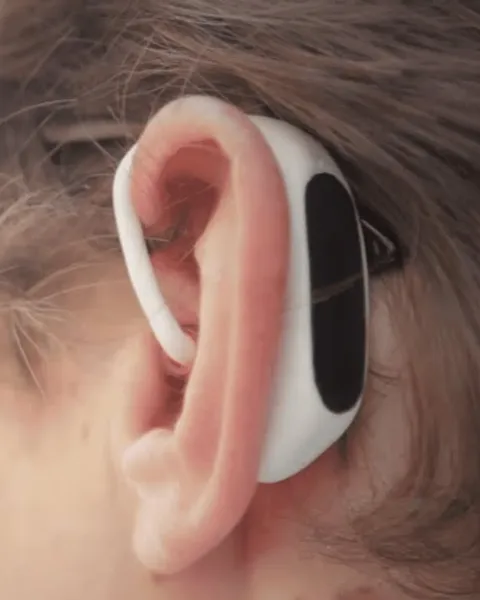
The Smart Bud is an earpiece you put in each morning and take out at night. Not a headset you dig out for a call and then put away: an object you forget you're wearing, and one that stays discreet because it leaves the ear open.
The ear canal is never blocked. Your usual soundscape stays intact, and the assistant's voice layers on top of it — as an extra layer, not a replacement. That's what makes the interaction fluid: you don't shut yourself off to listen, and you don't remove anything to talk to someone.
The other design decision concerns the rate of information. No more notifications landing continuously — only small reminders, when they're genuinely relevant. Wearing an object all day only makes sense if it knows how to stay quiet.
Specs
- Consumer TWS Bluetooth audio chip
- Balanced armature driver, as used in hearing aids
- Open-ear architecture — ear canal left clear
- Soft silicone shell
- Charges on a magnetic base, made for a bedside table
Progress
The prototype works and I wear it every day — that's the test that counts, to my mind, far more than a demo that succeeded once on camera.
Physically the object is deliberately simple: it builds on a consumer TWS Bluetooth audio chip rather than custom silicon. The difficulty lies elsewhere — in open-ear acoustics, and in comfort across sixteen hours straight.
Planned features
The refinement under way is physical: making the Smart Bud even less noticeable. The route I'm exploring runs beneath the ear rather than over the top, as it does today — the upper contour gets in the way for glasses wearers.
Sony attempted this approach with the Xperia Ear Duo. The idea was sound; it deserves another run with today's components and today's assistants.