Mini E-Reader
Concept and use cases
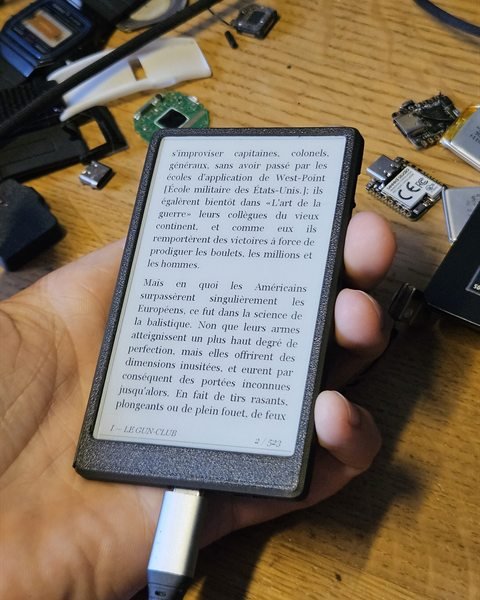
The Mini E-Reader is an e-ink reader stripped down to the essentials: a screen, a few buttons on the edge, a book. Almost card-sized, it sits in the palm of your hand and slips into a pocket next to a card holder. You pull it out in a queue to read ten pages instead of reaching for your phone again.
Its case is ultra-minimalist and ultra-slim: 8.6 mm thick, nothing more than the electronics require. The screen takes up almost the whole front, and the edges carry only what is needed: the buttons, a USB Type-C port and an SD card reader.
The project is open source and built on an ESP32-S3. Since the board also carries a speaker and a microphone, it is an open platform that can serve as a base for much more than reading.
Specs
- Waveshare ESP32-S3 3.97inch e-Paper Development Board
- 3.97-inch e-ink display — 800 × 480 px
- Ultra-slim, almost card-sized case — 8.6 mm thick
- USB Type-C
- SD card reader
- Built-in speaker and microphone
- Built-in Wi-Fi and Bluetooth LE
- Open source — case STL file on request
Progress
First unit assembled and working: the reader displays its books and already follows me outside the workshop. The Waveshare development board brings the screen, the ESP32-S3, the audio and the SD card reader together on a single PCB, which leaves all the design effort for the case.
That case is drawn as close to the electronics as possible, to get down to 8.6 mm thick. It is 3D-printed: the STL file is available on request, by direct message on X.
Planned features
With a speaker and a microphone already on board, the Mini E-Reader is meant as an open platform: a slim, open-source hardware base on which anyone can build something other than an e-reader.